
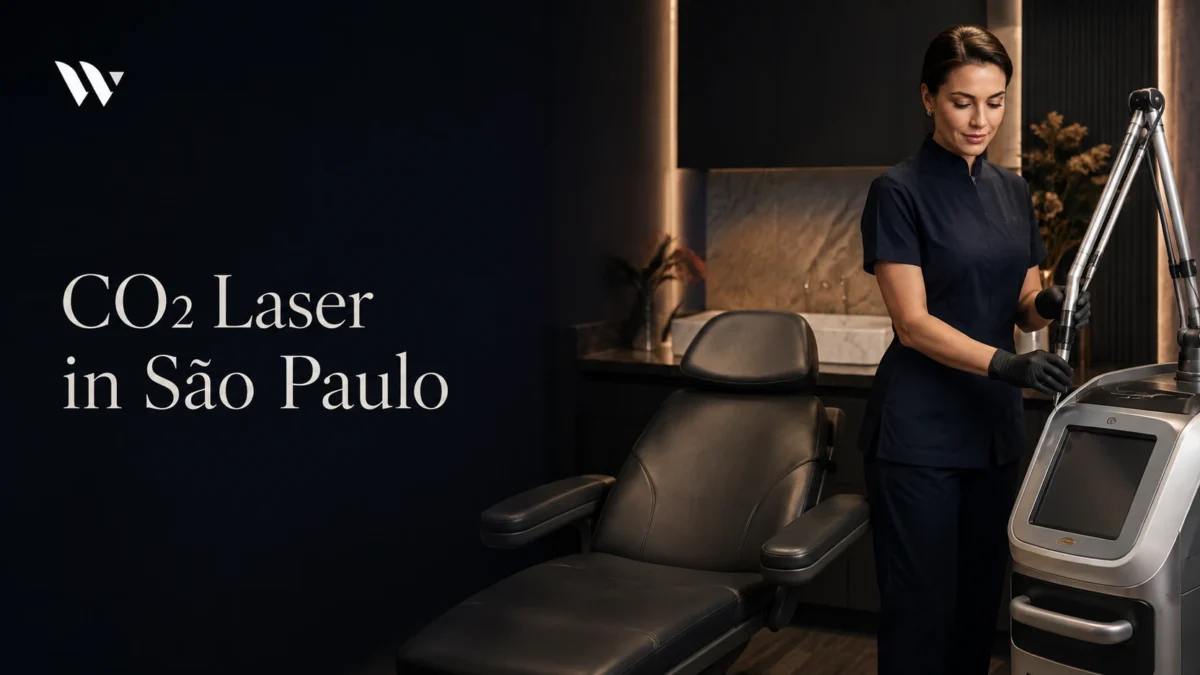
CO2 laser in São Paulo is a medical resurfacing procedure performed at Clínica Wulkan, a family dermatology clinic founded in 1985 and led by Dr. Claudio Wulkan (CRM-SP 90.579). Fractional CO2 laser treats wrinkles, acne scars, rough texture and enlarged pores by removing microscopic columns of skin so new collagen forms. Prices are in Brazilian reais and confirmed after a medical evaluation.
Table of Contents: CO2 laser in São Paulo
- What a fractional CO2 laser actually does
- What CO2 laser resurfacing treats
- What a session is like, step by step
- Real downtime: day by day recovery
- Safety on darker and more pigmented skin
- Where to have CO2 laser in São Paulo
- How much CO2 laser costs in reais
- Planning treatment as an international patient
- What the science shows
- FAQ — CO2 laser in São Paulo
Dr. Claudio Wulkan is a specialist in fractional CO2 laser in São Paulo — and in choosing when not to use it, which matters just as much with an ablative laser. He works with more than 20 laser and energy-based platforms and teaches other physicians how to operate them, in hands-on and online courses for doctors: when your doctor trains other doctors on the equipment, you are not the person he is learning on. He is a dermatologist registered under CRM-SP 90.579 with specialist qualification RQE 39.944, graduated in Medicine at UNIFESP — Federal University of São Paulo in 1997, part of the staff of Hospital Israelita Albert Einstein, with around 30 years of clinical practice and more than 300 courses and international congresses attended over the decades.
CO2 vaporises tissue, so depth, density and your phototype have to be decided by a dermatologist who examines your skin — not by a standard setting. Clínica Wulkan is a family practice founded in 1985, with two units (Jardim Paulista and Osasco), so if you want CO2 laser in São Paulo performed safely, in a medical environment, after an individual evaluation — including an honest opinion on whether another technology suits you better — you are in the right place.
What a fractional CO2 laser actually does
A CO2 laser emits light at 10,600 nm, a wavelength absorbed almost entirely by the water in your skin. That energy vaporises tissue with precision — this is why CO2 is called an ablative laser. In the fractional version used today, the beam is split into a grid of microscopic columns, so only a fraction of the surface is treated in each pass, and the untreated skin between the columns drives fast healing.
The result is two effects at once. On the surface, damaged skin is removed and replaced by new epidermis, which improves texture, tone and fine lines. In the dermis, the controlled heat triggers months of collagen and elastin remodelling — the reason the result keeps improving for three to six months after the session, not only in the first weeks. For the full clinical detail in Portuguese, see our page on laser CO2 fracionado.
Fractional CO2 is not a non-ablative laser, a peel or radiofrequency. It is the most powerful resurfacing tool a dermatologist has for texture and scars — and precisely because it is powerful, dose and depth must be chosen for your skin, not copied from a protocol.
What CO2 laser resurfacing treats and where you can find CO2 Laser in São Paulo
The strongest indications for fractional CO2 laser resurfacing in São Paulo are:
- Facial rejuvenation: fine wrinkles, crepey skin around the eyes and mouth, sun damage and overall dullness;
- Acne scars: especially atrophic (depressed) scars — boxcar and rolling types respond best, often combined with subcision;
- Skin texture and enlarged pores: smoothing an irregular surface and refining pore appearance;
- Surgical and traumatic scars: softening raised or retracted scars and improving colour match;
- Stretch marks: improving texture in mature (white) stretch marks;
- Actinic damage and pre-cancerous change: field treatment of sun-damaged skin, always under dermatological assessment.
Acne scarring deserves a note: no single tool corrects every scar type, and the honest plan is usually a combination — subcision for tethered scars, CO2 for texture, sometimes filler or a biostimulator for volume. Our Portuguese page on laser de CO2 para cicatriz de acne explains how those layers are staged. CO2 is not the first choice for melasma, where heat can worsen pigmentation — a thulium laser or other approach is usually safer.
What a session is like, step by step
Treatment starts with a medical consultation, not with the laser. Dr. Wulkan examines your skin, classifies your phototype, reviews your history — isotretinoin use, herpes, keloid tendency, recent sun exposure — and decides whether CO2 is the right tool at all. Photographs are taken for comparison.
On the day, topical anaesthetic cream is applied for 40 to 60 minutes; for deeper settings, local anaesthetic or nerve blocks may be added. The pass itself takes 20 to 40 minutes for a full face and feels like heat with a rapid prickling sensation, with cold air for comfort. You leave with the skin red and warm, and with a written aftercare plan: gentle cleansing, an occlusive healing ointment, no sun, and strict photoprotection once the skin has closed.
Ask about CO2 laser on WhatsApp (all languages)
Real downtime: day by day recovery
Downtime is the single most common reason patients hesitate, so here is a realistic account for a moderate fractional CO2 setting on the face. Individual healing varies, and deeper settings mean longer recovery.
- Days 1–2: intense redness, heat and swelling, similar to strong sunburn; the skin oozes slightly and must stay covered in ointment;
- Days 3–5: swelling settles; the treated grid becomes visible as a fine bronze pattern and the surface starts to flake;
- Days 5–8: peeling completes and new, pink skin appears — most patients are presentable with mineral make-up around day 7;
- Weeks 2–4: residual pink tone fades gradually; sun avoidance remains essential;
- Months 3–6: collagen remodelling continues and the final texture improvement becomes visible.
Planning matters: one meaningful session needs about a week away from social and professional exposure, and sun during recovery is the main avoidable cause of unwanted pigmentation.
Safety on darker and more pigmented skin
Brazil is one of the most phenotypically diverse countries in the world, so a dermatologist practising here treats the full range of Fitzpatrick phototypes every day — experience that is directly relevant if your skin is not pale. In more pigmented skin, the specific risk after ablative laser is not usually scarring but post-inflammatory hyperpigmentation: a temporary darkening as melanocytes react to the inflammation of healing.
That risk is managed, not ignored: conservative density and energy, fewer passes, careful pre-treatment of any active melasma, sometimes a preparatory topical regimen, and rigorous photoprotection during recovery. For phototypes V and VI, a dermatologist may recommend a different technology altogether rather than pushing CO2 — a judgement made in person. No procedure carries no risk, and any indication here depends on medical assessment.
Where to have CO2 laser in São Paulo
Clínica Wulkan is a dermatology clinic founded in 1985 by Dr. Wulkan’s father, with Dr. Claudio Wulkan practising here since 2000. It operates at two units — Jardim Paulista, in central São Paulo, and Osasco Centro — and owns more than 20 laser and energy-based platforms, including fractional CO2, the Lavieen thulium laser, Etherea MX, Ultraformer MPT and HIPRO for microfocused ultrasound, Volnewmer, Thermage and Oligio X for monopolar radiofrequency, Secret and EndyMed for RF microneedling, and Soprano Titanium and Platinum for hair removal.
Owning that many platforms matters for one reason: a clinic with a single device tends to recommend that device. Here, CO2 is offered when CO2 is the right answer, and something else when it is not. For the wider overview of the equipment available, see our page on laser treatments in São Paulo.
Every laser procedure here is performed or supervised by Dr. Claudio Wulkan, a UNIFESP-trained dermatologist (1997) and member of the medical staff at Hospital Israelita Albert Einstein.
How much CO2 laser costs in reais
CO2 laser is quoted in Brazilian reais (R$) and the value depends on the area treated, the depth and density chosen, and how many sessions your diagnosis requires — a single perioral pass and a full-face acne-scar programme are different procedures. The exact value is confirmed after a medical evaluation, in writing, with no hidden costs and no pressure to decide on the day.
We deliberately do not advertise a headline figure, because an honest quote depends on examining your skin. The plan is always discussed together with its price before anything is scheduled.
Planning treatment as an international patient
Patients travelling from abroad are welcome. Our team answers WhatsApp with translation support in all languages, so the first assessment can begin before you fly: send photographs and your history, and we will tell you honestly whether CO2 is indicated and how much time in São Paulo it needs.
Three points to plan around. First, allow seven to ten days in the city after a meaningful session, so the peeling phase happens before you travel again. Second, do not schedule CO2 at the start of a beach or high-altitude holiday, because sun exposure during healing is the main cause of pigment problems. Third, follow-up can be done online after you return, with photographs, and a written aftercare plan travels with you.
What the science shows
Evidence on fractional CO2 continues to accumulate, including for skin that is not pale. A 2026 retrospective cohort study published in the Journal of Cosmetic Dermatology by Oloruntoba and Rodrigues assessed the safety and tolerability of fractional CO2 lasers for facial rejuvenation across Fitzpatrick skin phototypes I to IV (PubMed, 2026). Work of this kind is the reason a dermatologist adjusts settings to phototype rather than applying one protocol to every patient — the clinical judgement behind the machine is what turns a powerful laser into a safe one.
FAQ — CO2 Laser in São Paulo
Where can I have CO2 laser in São Paulo?
At Clínica Wulkan, a dermatology clinic founded in 1985 and led by Dr. Claudio Wulkan (CRM-SP 90.579), with two units in Jardim Paulista, São Paulo, and Osasco Centro, and more than 20 laser and energy-based platforms including fractional CO2.
How much downtime does fractional CO2 laser need?
For a moderate full-face setting, expect two days of marked redness and swelling, flaking from day three to day eight, and residual pink tone for two to four weeks. Most patients are presentable with mineral make-up around day seven, and deeper settings mean longer recovery.
Is CO2 laser safe on darker skin?
It can be, with conservative settings and careful preparation, but the specific risk in more pigmented skin is temporary post-inflammatory hyperpigmentation. For higher phototypes a dermatologist may recommend a different technology instead. No procedure is free of risk and the decision requires an in-person assessment.
How much does CO2 laser cost in São Paulo?
It is quoted in Brazilian reais and depends on the area, the depth and density used, and the number of sessions your diagnosis requires. The exact value is confirmed after a medical evaluation, in writing.
How many sessions are needed for acne scars?
Acne scarring usually needs more than one session, and often a combination of techniques such as subcision for tethered scars alongside CO2 for texture. The number is defined after examining which scar types you have.
Can CO2 laser treat melasma?
CO2 is generally not the first choice for melasma, because the heat can aggravate pigmentation. A thulium laser or another approach is usually safer, which is one reason a clinic with several platforms is an advantage.
Do you treat patients who do not speak Portuguese?
Yes. Our team answers WhatsApp with translation support in all languages, from the first message through aftercare, and an online pre-assessment can be done before you travel to Brazil.
Deciding on CO2 laser in São Paulo means deciding who sets the parameters. Dr. Claudio Wulkan is a dermatologist with CRM-SP 90.579 · RQE 39.944, a medical degree from UNIFESP (1997), staff at Hospital Israelita Albert Einstein, around 30 years of practice, 300+ international courses and congresses, more than 20 laser and energy platforms in routine use — and he teaches those platforms to other physicians. Depth, density, number of sessions and whether CO2 is even the right laser for your phototype are all defined in your evaluation.
Book your CO2 laser in São Paulo evaluation at Clínica Wulkan
Your parameters will be set by Dr. Claudio Wulkan — dermatologist, CRM-SP 90.579 · RQE 39.944, UNIFESP 1997, Albert Einstein staff, around 30 years of practice and a teacher of laser technologies to other doctors. Two reference units — Jardim Paulista (São Paulo) and Osasco — a family dermatology practice since 1985, more than 20 technologies, and a team that will assess your skin honestly and tell you whether CO2 is the right choice. Every plan starts with a medical evaluation; nothing here is a promise of results.